
Overview
The creation of Eridia, the first dragons, and the draconic empires that ruled before mortal kingdoms.
What Happened
In the nascent epoch of the cosmos, when the celestial bodies were but infants in the cradle of existence, and the darkness reigned supreme, untouched by the brilliant radiance of creation, a cosmic entity stirred within the void. This entity bore the name Beral, an enigmatic primordial force, a divine being endowed with the power to create and annihilate entire worlds with a mere whisper of thought.
Beral, with his boundless wisdom and omnipotent might, cast his gaze upon the vast, uncharted expanse of the universe and made the decision to forge a world of his own. And thus, the artistry of creation began, molding the tender, embryonic planet that would eventually be known as Eridia.
In his celestial wisdom, Beral sundered chaos and order upon this nascent world, maintaining a delicate equilibrium between the two. From this division, a cataclysmic explosion erupted, heralding the birth of life in the universe. From the void of nonexistence, Beral brought forth three colossal landmasses: Amra, Nivarie, and Varinthia.
Amra, the central continent and the very heart of Eridia, boasted expansive plains, dense forests, towering mountains, and coursing rivers. This sanctuary was home to a myriad of creatures, some gentle and benign, while others posed a menacing danger. It was here that great cities, fortresses, and temples were erected, bastions where the people of Eridia could pay homage to their gods and find solace in times of strife.
Nivarie, nestled to the southeast of Amra, was a land shrouded in enigma and peril. Legend has it that its surface was blanketed with impenetrable jungles, which, over eons, birthed untamed tribes of wild beings and formidable creatures. Ancient beasts slumbered beneath the earth, their power and ferocity unmatched. Scholars have found that sages who dared to venture into Nivarie in pursuit of arcane knowledge and hidden treasures seldom returned. The annals of history scarcely document Nivarie in detail, leading some to question the veracity of these tales or even the existence of the continent itself.
Varinthia, situated west of Amra, was a realm of wonder and enchantment. Majestic mountains and verdant forests coalesced into landscapes that seemed to have been plucked from the pages of a fairy tale. However, the energies that birthed Eridia had left their mark upon the land, engendering creatures and beings that straddled the boundary between the mortal plane and that of the elements.
The dragons, Amra's primordial inhabitants, were bequeathed with the sacred duty of preserving the memory of creation and passing it down through the generations. Legend tells of the great mother of the gods, Beral, who wrought dragons as a divine and formidable race. Yet, their creation was a laborious and exacting process, necessitating the aid of the twin moons, Dener and Iothas.
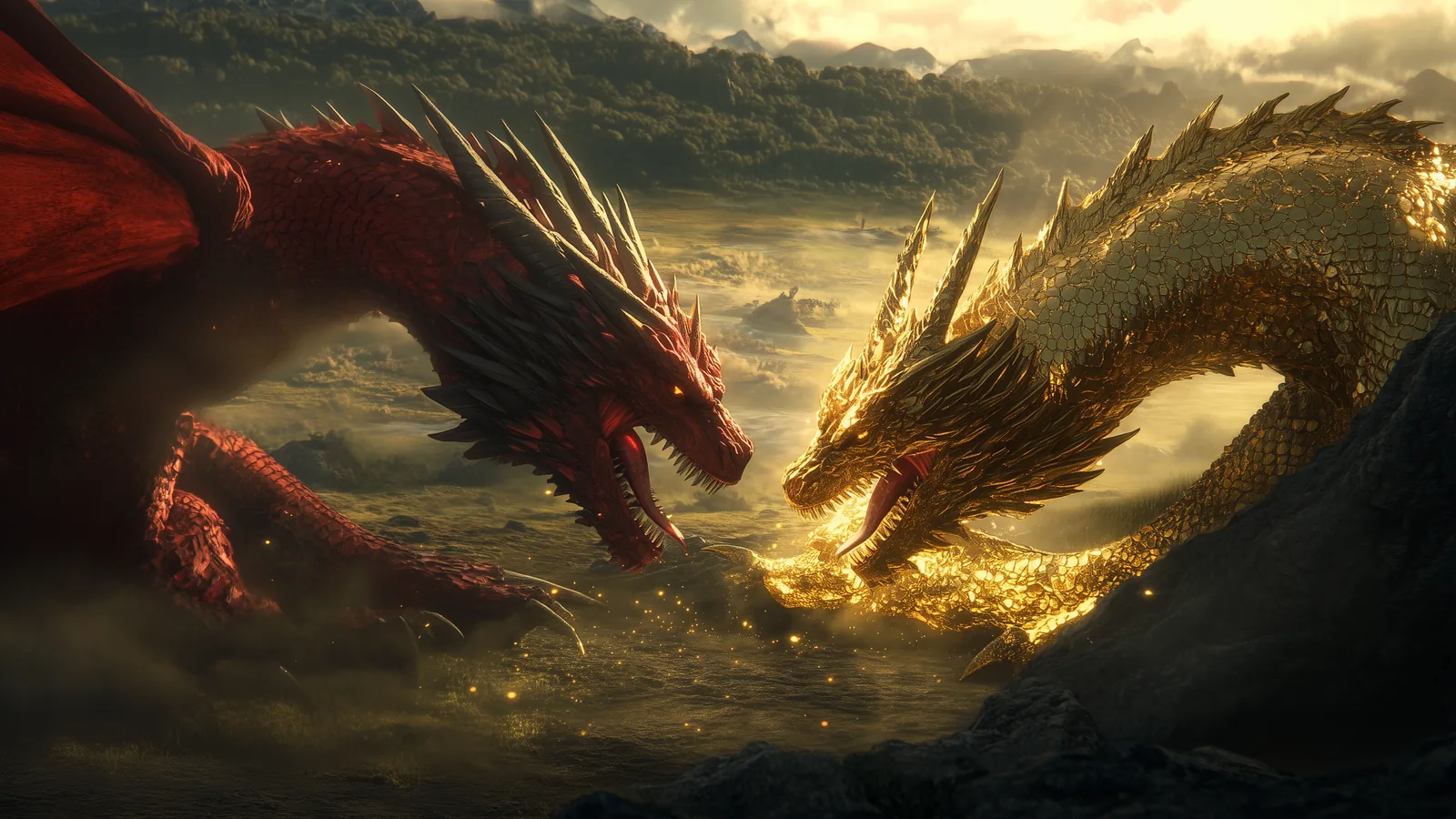
Beral entrusted the lunar siblings with the task of imbuing the dragons' eggs with the essence of the elements. The argent moon, Dener, suffused the eggs with the essence of metals, giving rise to the metallic dragons, resplendent in hues of gold, silver, copper, and more. In contrast, the crimson moon, Iothas, infused the essence of chromatic elements, breathing life into the vibrant chromatic dragons: red, green, blue, and others.
The dragon eggs, steeped in the elemental essences, began to radiate with a magical brilliance, hatching over countless lunar cycles. From these shells emerged the first dragons, each endowed with the properties of the element bestowed upon them.
As the dragons ventured forth, they discovered they had been granted extraordinary abilities: prodigious strength, astonishing speed, razor-sharp intellect, and mastery over the magic of the elements that had been gifted to them. With these powers, the dragons ascended to dominance in Amra, reigning over the lesser creatures and erecting vast empires in their name.
Yet, despite their immense power, dragons were also creatures of immense pride, often embroiled in internal strife for dominion and wealth. However, all dragons shared a profound reverence for their creators, Beral and the twin moons, bestowing them with tributes and offerings as a testament to their respect and gratitude.
In time, the dragons came to the realization that they required a workforce to construct and maintain their grand cities and fortresses. Thus, they commenced experiments in the creation of new life forms.
Employing their magic and abilities to manipulate the elemental energies of the world, the dragons breathed life into the first beings to populate Amra. Among them were the Kobolds, small and cunning creatures, fashioned to labor in the mines and erect structures. The Yuan-ti, serpentine humanoids, were birthed to serve as soldiers and guardians of the cities. The Dragonblood, a hybrid race of humans and dragons, possessed superior magical and physical prowess and were created to be the closest and most loyal servants of their draconic masters. Moreover, they crafted various monstrous entities to bolster their armies.
As these new races flourished, the dragons splintered into disparate factions, each crafting their own beings to suit their aspirations and requirements.
Rivalry amongst the dragons was a matter of pride and honor. Each dragon harbored their own vision for the world and their role within it, often pitting them against one another in bitter struggles for power and resources. While the dragons were both revered and feared by the other inhabitants of Amra, their avarice and egotism frequently jeopardized the delicate balance of elemental forces and nature itself.
Initially, the skirmishes between dragons were minor and infrequent. However, as the ages rolled on, these rivalries intensified, and conflicts grew increasingly violent and recurrent. The dragons plunged into a vortex of destruction and chaos, leaving a trail of devastation in their wake.
During this tumultuous period, many of the metallic dragons chose to abandon Amra, seeking refuge with Dener. The few metallic dragons that remained did so out of love for the world they had sculpted and the creatures they had brought to life.
Nevertheless, the escalation of violence among the chromatic dragons seemed insatiable. Eventually, the situation reached a boiling point. The conflicts between the dragons had intensified to such a degree that the very survival of Amra was at stake.
Distressed for the future of her creation, Beral resolved to forge the first Titans, towering, formidable beings capable of counterbalancing the might of the dragons. Beral sculpted the Titans from the very earth and rock of Amra, imbuing them with the power to reshape the world according to their will.
As the Titans toiled upon the world, the dragons, envious of the Titans' capacity to mold the world, began to wage war against them, instigating a conflict that would ravage Amra for centuries. This cataclysmic war would become known as the Black Blood War, a dark chapter in Amra's history that reverberated throughout the entire world.
The battle between dragons and Titans scarred the face of Amra, but it also provided an opportunity for new races and civilizations to rise from the ashes. Though the world would never return to its former glory, the story of the dragons and their legacy would endure in the tales and legends of generations to come.
Lasting Consequences
This event still affects politics, religion, ruins, bloodlines, and the way scholars explain danger in the present age. Its relics and unresolved wounds can surface as diplomatic pressure, sacred duty, inherited guilt, or a forgotten threat returning from beneath the official histories.
Campaign Use
- Use this entry to anchor ruins, prophecies, noble claims, or old enemies in a specific age.
- Let modern factions disagree over what the event means and who has the right to inherit its legacy.
- Connect discoveries from this period to nearby region, god, species, or faction entries.