
Overview
The negotiations that ended elven-human war and defined the political borders of the central kingdoms.
What Happened
In the shadows of a conflict that had ravaged Amra for years, the leaders of Tel'Donor, Tel'Dovan, and Tel'Areth convened to address the escalating tension between elves and humans. With the monstrous creatures from The Peaks of the Draken encroaching upon their lands, and whispers of the dragons' return unsettling the hearts of every denizen of Amra, the urgency of the situation could not be ignored.
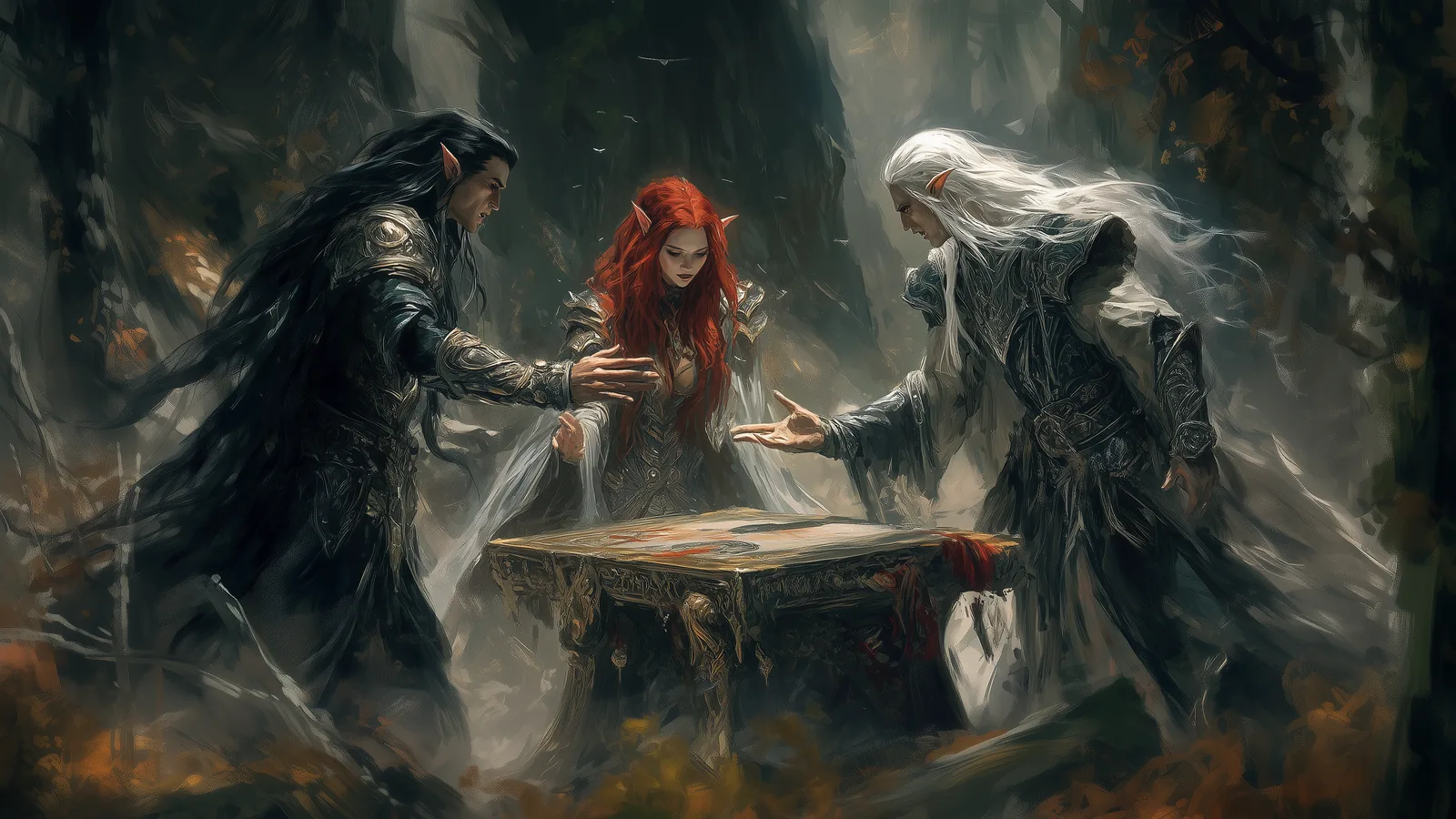
The regents of the elven kingdoms, Gaeladrian Korianthos, Naiadriel Eglaneth, and Arathiel Aelarion, gathered to discuss a momentous proposal. They contemplated ceding a portion of their lands to the humans, allowing them to expand eastward and establish a realm of their own. In exchange, the humans would be entrusted with the defense of these lands and forge an alliance between the kingdoms of elves, humans, and dwarves to face the imminent threat of dragons.
During the arduous negotiations of The Capitulations of the Hundred Nights, opinions clashed and tempers flared. Each regent championed their own vision for the future of the eastern lands.
Arathiel Aelarion, the stoic regent of Tel'Areth, vehemently opposed granting any elven territories to the humans. He believed that such a concession would only attract more formidable foes to Amra's borders and insisted on finding an alternative solution.
Gaeladrian of Tel'Dovan, however, saw potential in human expansion. The opportunities for cultural exchange and trade enticed him, leading him to advocate for the ceding of some eastern lands.
Naiadriel Eglaneth of Tel'Donor tread a more moderate path, seeking a compromise that would respect both elven and human interests. She agreed to part with some of the land, provided that the humans honored elven borders and refrained from meddling in their affairs.
As the debates raged on, rumors of skirmishes and conflicts between the elven representatives spread like wildfire. The Capitulations of the Hundred Nights eventually culminated in the temporary separation of Tel'Areth from its sister kingdoms, Tel'Donor and Tel'Dovan, easing the tensions between the elven nations.
Despite Tel'Areth's refusal to recognize the treaty, new borders between the human and elven realms were established, and they vowed to maintain a relationship of respect and cooperation with the House Dawnspear.
The Dawnspear lineage, a noble human house rooted in the mountainous territory of Aregor, was assigned the responsibility of governing the newly minted lands soon to be known as Castell. This appointment was a direct result of the House's prestigious reputation, particularly the heroic actions of their leader, Arin Dawnspear, during a tumultuous conflict between humans and elves. It was Drogan Silverbeard, a dwarf of Dhon Toruhm well-acquainted with the human kingdoms, who recommended the Dawnspears, considering their martial prowess and diplomatic acumen.
To bolster the stability of the emergent kingdom, the dwarves from Dhon Toruhm were summoned to oversee the execution of the agreement. Eager to reconnect with the wider world after lengthy epochs of isolation, the dwarves deployed their expertise in the formation of the Triumvirate of Castell.
This coalition involved the noble families of Castell, the elven kingdom of Tel'Dovan, and the dwarven realm of Dhon Toruhm. Under this system, each noble family of Castell was allotted a representative from Tel'Dovan, designated as the Master of Magic, and a representative from Dhon Toruhm, titled the Master of Defenses.
Whilst some elves elected to depart the continent, many chose to remain in Castell to help the humans settle their new lands and mediate disputes with their neighbors in Tel'Areth. In an enduring state of vigilance, they also maintained watch over the ominous Peaks of the Draken.
Amid an environment of strife and uncertainty, the Triumvirate of Castell was born. This unprecedented alliance of humans, elves, and dwarves was determined to navigate the hazardous currents of political intrigue and potential conflict while defending their lands from the monstrous creatures at their borders.
As the wheel of time turned, the lands of Castell flourished under the judicious and equitable rule of House Dawnspear. Guided by the Masters of Magic and Defenses, Castell managed to create a delicate balance of power in the region, ensuring peace and stability for its populace.
Cultural exchange among the inhabitants of Castell and their elven and dwarven allies enriched the kingdom, fostering a sense of unity and understanding that eclipsed the confines of race and heritage. As the years progressed, the bond of friendship and trust between the three realms grew stronger, fortifying the Triumvirate of Castell against external threats.
Although the shadow of the dragons cast a significant dread in the hearts of the people of Amra, the unity of elves, humans, and dwarves stood as a beacon of hope and resilience. Together, they faced the impending challenges, resolved to protect their lands and safeguard the future of their people.
The establishment of the Triumvirate of Castell would be remembered in the annals of history as a powerful testament to unity and cooperation amid adversity. The legacy of the Accords of the Broken Spears and the brave regents who pioneered a path toward peace would resonate, inspiring future generations.
Lasting Consequences
This event still affects politics, religion, ruins, bloodlines, and the way scholars explain danger in the present age. Its relics and unresolved wounds can surface as diplomatic pressure, sacred duty, inherited guilt, or a forgotten threat returning from beneath the official histories.
Campaign Use
- Use this entry to anchor ruins, prophecies, noble claims, or old enemies in a specific age.
- Let modern factions disagree over what the event means and who has the right to inherit its legacy.
- Connect discoveries from this period to nearby region, god, species, or faction entries.