
Overview
The great elven war against Drakorax and the tragedy that reshaped Tel Donor.
What Happened
The Second Alliance's clashes against the Chromatic Dragon Empire came to be known as The War of the Thousand Tears. This arduous and brutal series of battles forged the Second Alliance, an indomitable coalition of elves, titans, and dwarves, whose purpose was to confront the ever-expanding Chromatic Dragon Empire, ruled by the dreaded and formidable Great Drakorax.
Throughout the war, the Second Alliance faced innumerable challenges and adversities. The leaders of the alliance refined their tactics and strategies, melding their expertise to maximize each race's strengths. Dwarves crafted weapons and armor, elves wove spells and enchantments, and titans brought their immense might and endurance to bear.
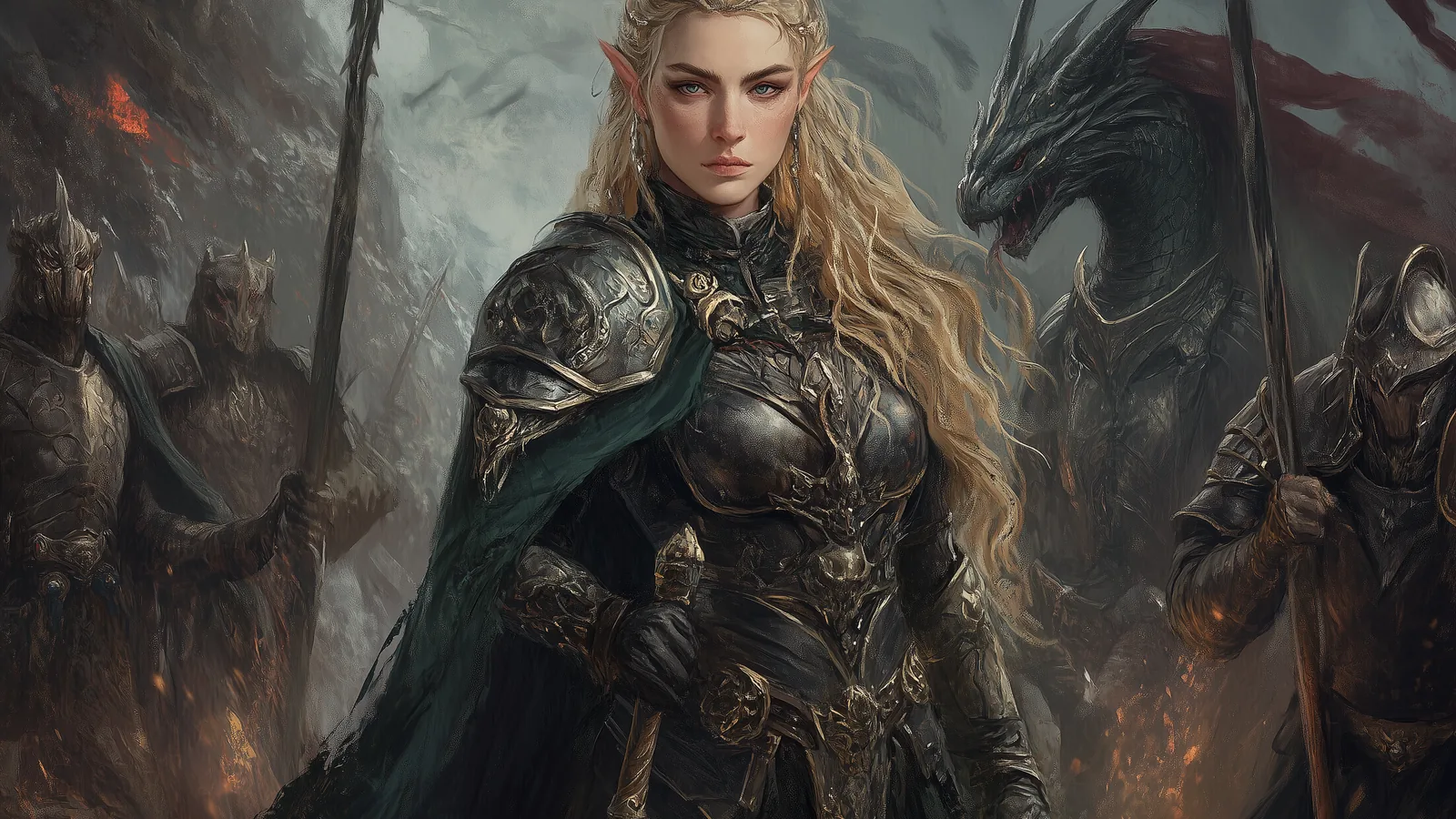
Legendary heroes from each race arose in the midst of the war, their names etched into the annals of Amra's history. Among them were Elladan, the courageous elf who led the charge against a brood of black dragons; Yavanna, the elven archmage, whose heartache at her son's loss reverberated throughout the realm; Thorgar Runehammer, the dwarven master smith; and Liraniel, the Forest Warrior.
The Battle of Ascalon proved to be a pivotal engagement in the War of a Thousand Tears. In this fierce confrontation, Elladan and his elven forces faced a formidable pack of black dragons on the sweeping plains of Ascalon. Despite the dragons' might and cunning, the elves emerged victorious, employing magical traps and enchanted weaponry to vanquish their foes.
However, not all the war's battles yielded triumph for the Second Alliance. Archmage Yavanna commanded her forces in a perilous encounter against a colossal blue dragon in the craggy mountains of Gorgoroth. Despite their courage and skill, the elves suffered a crushing defeat, with countless lives lost, including that of Yavanna's son. Her inconsolable grief persisted for a thousand days and nights, giving the war its mournful moniker.
The War of the Thousand Tears reached its climax at the Battle of Peaks of the Draken, where the forces of the Second Alliance gathered for a final, monumental showdown against the Great Drakorax and his draconic legions.
In this epic confrontation, the armies of elves, titans, and dwarves fought in perfect harmony, capitalizing on each race's distinct skills and abilities. The dwarves, wielding their battle-axes, cleaved through the draconic ranks, while the titans, employing their brute strength, laid waste to all in their path. Meanwhile, the elves unleashed potent spells and magical arrows, wreaking havoc upon their adversaries.
The leaders of the various factions distinguished themselves in battle as well. Torum, King of Dhon Toruhm, fought with unmatched courage and skill, carving through the dragon ranks with his battle-ax and shielding the dwarves under his mantle of strength. Drogath, King of Dhon Vondaral, a master smith, wielded a mighty magical hammer of his own design, crushing dragons with each resounding blow. Hargrath, King of Dhon Mendor, renowned for his expertise in crafting ballistae, rained enchanted bolts upon the dragons, turning the sky into a veritable deluge of death.
The Titans boasted their own distinguished leaders. Among them were Kaela, a seasoned warrior and tactician who had directed the titans in several prior battles, and Angrath, a mighty titan who had been the first to join Gaeladrian and the dwarves in their struggle against the dragons. His brute strength and prowess in close combat were instrumental in securing the ultimate victory.
At last, after a long and blood-soaked battle, Gaeladrian and his companions reached the very heart of the dragonarmies, where the Great Drakorax, the most formidable of them all, lay in wait. The ensuing confrontation was nothing short of epic, but eventually, Gaeladrian managed to utilize his magical abilities to weaken Drakorax to the point that his comrades could deliver the final, decisive blow.
With the demise of the Great Drakorax, the remaining dragons began to falter and retreat, ultimately fleeing the battlefield in defeat. The war was finally over, and balance had been restored to the world of Amra. From that moment on, the diverse races of the Second Alliance worked in unison to protect and preserve the world they had fought so fiercely to defend.
The War of the Thousand Tears left an enduring legacy on Amra. The tales of the Second Alliance's bravery and sacrifice evolved into legends that would inspire generations to come. The collaboration of elves, dwarves, and titans in their common struggle demonstrated to all inhabitants of Amra the power of unity and cooperation in the face of adversity.
Thus, the world of Amra was forever changed by the courageous efforts of the Second Alliance. The alliance's members, bound by shared experiences and mutual respect, continued to strengthen their ties long after the war had ended. Their union served as a testament to the importance of solidarity, and their sacrifices served as a reminder of the price paid to secure the fragile peace.
In the years that followed, the people of Amra focused on rebuilding their world, reconstructing the cities and towns that had been reduced to rubble by the destructive force of the dragons. The combined knowledge and skills of the elves, dwarves, and titans allowed for the creation of marvels never before seen, heralding a new age of prosperity.
As the memories of war began to fade and life returned to a semblance of normalcy, the heroes of the Second Alliance, their names immortalized in legend, served as enduring symbols of hope and resilience. And so, the world of Amra forged on, forever shaped by the War of a Thousand Tears and the indomitable spirit of those who fought to protect it.
Lasting Consequences
This event still affects politics, religion, ruins, bloodlines, and the way scholars explain danger in the present age. Its relics and unresolved wounds can surface as diplomatic pressure, sacred duty, inherited guilt, or a forgotten threat returning from beneath the official histories.
Campaign Use
- Use this entry to anchor ruins, prophecies, noble claims, or old enemies in a specific age.
- Let modern factions disagree over what the event means and who has the right to inherit its legacy.
- Connect discoveries from this period to nearby region, god, species, or faction entries.